
How to Stop Food Getting Under Your Dentures
Dental Implants


Picture this - you're having lunch with your daughter. Halfway through the sandwich, a sesame seed from the bread slides under your top denture. You keep nodding along, work at it with your tongue, and wait for a moment to slip off and rinse. Next time, you order the soup.
A lot of patients tell us it's the small stuff that wears on them over time - like passing on the bun with seeds, or leaving the berries on the plate.
If that sounds familiar, you're not alone, and it isn't something you're doing wrong. Food getting under your dentures at every meal usually has a reason, and most of the time, there's something that helps.
Why It's Easy to Think This Is Just Part of Wearing Dentures
Rinsing after meals is such a common routine for people with dentures that when food keeps slipping under, it feels like the price of having dentures at all.
A lot of patients tell us they've thought the same thing: It's just part of it. I'll work around it.
That's a fair thing to believe. But there's a difference between a crumb now and then and a problem at every meal. A little now and then is normal. Food working its way under at every meal isn't, and it usually means the denture is moving more than it should. What you order shouldn't be decided by your dentures.
Why Does Food Get Under Your Dentures?
Usually because the denture moves a little every time you bite.
A full denture sits on your gums. It's held in place by how closely it fits and by suction. Each bite can tip it slightly, and that opens a small gap at the edge. Seeds, nuts and crumbs find that gap. That's the gritty feeling halfway through a meal.
The gap tends to grow over time. Your gums change shape after your teeth are gone, but the denture keeps the shape it was made in. So, a denture that fit well when you got it can start to rock or shift a bit over time. (We explain more about why dentures can start to feel loose in a separate post.)
Food that stays trapped under the denture can also rub your gums and leave sore spots that make chewing hurt.
Food that sticks to the outside of your dentures is a different problem. That's mostly about daily cleaning. Food that gets underneath is usually about fit.
If you wear a partial denture, the same idea applies: when food gets under it often, a fit check is the place to start.
How to Keep Food from Getting Under Your Dentures
Some of this you can start at your next meal.
- Take smaller bites. They're easier for the denture to handle without tipping.
- Chew on both sides at once. Even pressure keeps the denture steadier than chewing on one side.
- Go easy on seeds and nuts. They're small and hard, and they're the usual culprits.
- Rinse after meals. It clears anything that got under before it starts to rub.
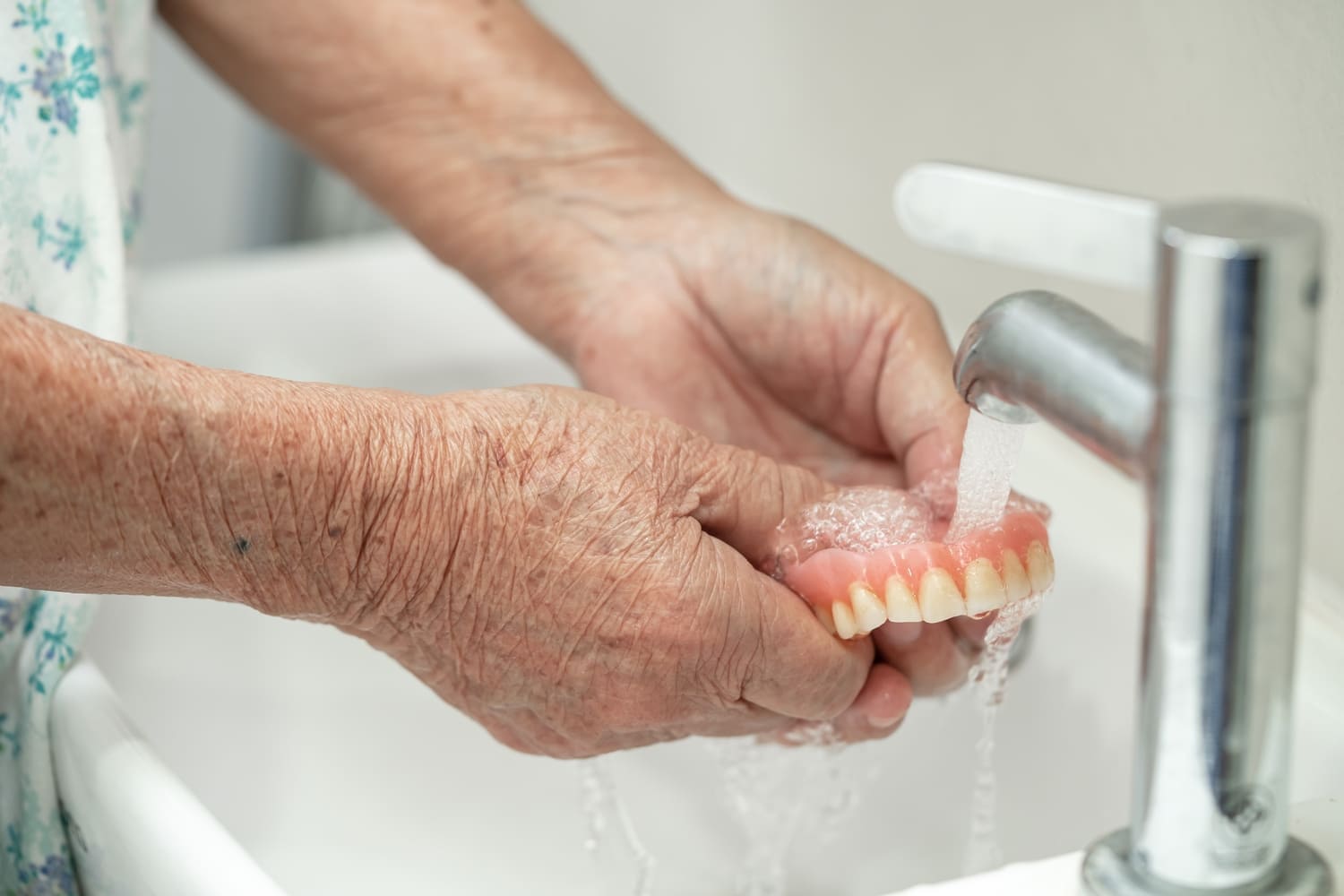
- Clean your dentures and your gums every night. Cleaning your dentures every night keeps the gums under them in good shape, which helps the denture sit the way it should.
Adhesive can help for a while. Some creams are sold as a "food barrier," and they can seal the edge of the denture for part of the day. But it's a patch you put on every morning, not a fix. Plus, it's not a terribly enjoyable experience (and the costs add up over time, too!). If you're tired of reaching for adhesive, you're not the only one.
A fit check is where to start. If food gets under your dentures at most meals, the fit has likely changed. A reline reshapes the inside of your denture to match your gums as they are now, often the same day or within a couple of days. The fit is snug again, so less tends to get in. And if a new fit needs a tweak, adjustments are free for 90 days.
If food has left a sore spot that isn't settling, don't wait for it to pass. Call your closest Saberton clinic and we'll take a look. A sore spot usually means the denture is pressing or rubbing in one place, and that's often a quick adjustment.
What helps, step by step
Start at the top and work down. Your denturist can tell you where your fit is today.
Small habits
At the table: Steadier bites, fewer bits slipping under.
Smaller bites, chewing on both sides, rinsing after meals. Free, and you can start at your next meal.
Adhesive
At the table: Seals the edge of the denture for part of the day.
Applied every morning, and often again later. A patch, not a fix.
Reline or refit
At the table: A snug fit again, so less tends to get in.
Your denturist reshapes the inside of your denture, often the same day or within a couple of days.
Dentures on implants
At the table: Much steadier when you bite, with much less room for food.
Your denture snaps onto two to four implants placed by our surgical partner. It still comes out at night to clean.
Denture on a bar
At the table: A solid, steady feel when you chew.
Four implants joined by a slim bar, and the denture clips on. It still comes out for cleaning.
When Food Keeps Getting Under Your Dentures, Even After a Reline
Sometimes a reline helps for a while, and then the same thing starts again. That's when it's worth knowing there's another option.
Does food still get under snap-in dentures? Much less, because the denture rocks much less when you bite.
With dentures on implants (DOI), two to four small implants are placed in your jaw, and your denture snaps onto them. The implants hold the denture in place, so you can bite into the sandwich with far less shifting and far less room for food to get under. It still comes out at night to clean, and that gives your gums a rest overnight. You may have heard this called snap-in dentures.
Wondering about the dentures you have now? Here's whether implants can be added to the dentures you already have.
For some people, a denture on a bar (DOB) is the better fit. Four implants are joined by a slim bar, and the denture clips onto it. It gives a solid, steady feel when you chew, and it still comes out for cleaning.
Your denturist plans the case; our surgical partner places the implants. You're looked after by one team the whole way through.
Which option fits depends on you, and how long you've worn dentures is part of it. When did you lose your teeth? is one of the first things we'll ask. If it's been a long time, here's what years in dentures means for implants. You can also see the three implant options, explained, before you talk to anyone.
The free initial discussion is a short first conversation with the Saberton team. We'll ask what's happening at meals, how long you've worn dentures, and what you've already tried. Then we'll walk you through what could help, from a reline to dentures on implants, and what each one involves. Nothing gets decided on that call, and there's no commitment.
Not sure which step fits you?
Start with a short, free first conversation with the Saberton Denture & Implant team. We'll talk through how your dentures fit and which options are worth a look. No commitment.
You Don't Have to Plan Every Meal Around Your Dentures
Food getting under your dentures is common, but it isn't something you have to keep putting up with. Whether the answer is a few small habits, a reline, or a denture that's held in place, it starts with someone looking at how your dentures fit today. Lunch with your family shouldn't mean planning your order around your dentures!
With 8 clinics serving residents across Ontario, a free initial discussion with a denturist at Saberton Denture & Implant can tell you plainly whether a reline solves it, or whether dentures on implants are worth a closer look.
Book your free initial discussion today
Have questions? Fill out our contact form to tell us about your needs.
Related Posts

Adding implants doesn't mean starting over. Here's what a denturist looks at, and why a new set isn't a step back.

Loose dentures usually mean bone changes, not something you did wrong. Learn why fit shifts and what actually helps.

Worn dentures for years and wondering if it's too late for dental implants? Learn what's possible with a free initial discussion.

Are implant-supported dentures removable? Saberton Denture & Implant explains what's true for each option, and what daily care actually looks like.

Three ways Saberton Denture & Implant secures teeth to implants, explained in plain English before your free initial discussion.

Snap-in dentures clip onto implants for stable, no-slip wear; traditional dentures rely on suction. See the difference and book a free consultation.

Using denture adhesive regularly? Learn why it’s common and explore more stable options like implant-supported dentures.

Thinking about dental implants after extractions? Learn what's possible, when to start, and how timing affects your options.

Facing tooth extractions? Learn how to think through the implants vs dentures decision before you commit, with calm, pressure-free guidance from Saberton.

After full tooth extractions, many people rush their next step. Learn the most common mistake, and how thoughtful denture planning can protect comfort and options.

Wondering if dental implants are still an option after full tooth removal? Learn how full-mouth implants work, timelines, and what to expect.

Learn how the timing of dentures after tooth extractions can affect comfort, healing, and future implant options. A clear, pressure-free guide.

Had teeth removed and unsure what comes next? Learn what to consider before choosing dentures, from healing time to long-term comfort.

Discover how digital dentures work, their benefits, process, costs and whether they’re right for your unique needs.

Learn how well-fitted dentures improve digestion, nutrition and overall health beyond your smile.

Lost teeth early? Discover why younger adults wear dentures, how to navigate this stage, and get confident with support from Saberton.

Starting with new dentures? Learn what to eat during your first few weeks, with specific guidance for complete and partial dentures. Tips for easier eating, foods to avoid, and how to adjust comfortably.

Explore dental implant options with clear, pressure-free guidance. Learn about implants, dentures on implants, costs, and CDCP coverage at Saberton.

Experiencing sore spots when eating with your dentures? Learn why it happens and how to fix it.

Discover the hidden risks of wearing your dentures overnight, and how removing them can protect your smile and health.
Learn how to care for your dentures with Saberton's complete guide. Daily routines, soaking tips, what to avoid, and when to see your denturist.

Get practical tips for chewing, talking, & eating with new dentures. Restore confidence & comfort with Saberton’s expert advice.

Discover how private insurance compares to Canada’s CDCP program for covering dentures. Find out what’s covered, eligibility, and book a FREE consultation today.

Discover how long getting dentures takes—from first visit, through fittings, to final fit. Saberton explains the denture timeline clearly and compassionately.

The right dentures, ones that actually fit your face, not just your mouth, can restore a surprising amount of facial support and confidence. Learn more by reading this post!

Wondering if Canada’s new dental program will help cover your dentures? You’re not alone. At Saberton, we get this question every day — and the answer is: yes, the Canadian Dental Care Plan (CDCP) does cover dentures. But, how much does it pay and who qualifies?

Implant-supported dentures offer better comfort, fit, and function than traditional options. Learn how they work, compare them to regular dentures, and discover if you’re a candidate.

Explore the best denture materials based on comfort, fit, durability, and cost. Compare acrylic, metal, and digitally made bases. plus composite and acrylic teeth. Get expert guidance from Saberton with free consultations and customized treatment plans.

Looking for affordable dentures in Ontario? Learn what to expect from cost-effective denture options, including fit, comfort, and maintenance. Discover financing, CDCP support, and expert care from licensed Saberton denturists.

Exciting news for Canadians! The Canadian Dental Care Plan (CDCP) is expanding its eligibility, making dental care more accessible to even more Canadians in need of affordable dental services.As of June 2025, all remaining eligible Canadians aged 18 to 64 will be able to apply for CDCP coverage. If you're looking for denture care or dental services and need financial assistance, now is the time to prepare.

The Canadian Dental Care Plan (CDCP) represents a landmark initiative in expanding access to essential dental services for up to 9 million Canadians. At Saberton, we specialize in guiding patients through the CDCP process, ensuring faster approvals, seamless paperwork, and high-quality dental care.

The holidays are upon us, and we are closing all clinics from Dec 24 to Jan 1, inclusive. Saberton will reopen on January 2, 2025!

We're thrilled to share some exciting news about Saberton’s continued growth and that is focused on delivering high quality denture care.

The CDCP coverage is based on pre-established treatment standards and patient income. Saberton helps patients understand these services and conditions clearly so they can plan accordingly and avoid unexpected charges.

The Canadian Dental Care Plan (CDCP) provides essential dental coverage for millions of Canadians. Learn how you can access these benefits with Saberton.

Explore the nuanced world of denture teeth quality with Saberton, where we delve into the balance between cost, aesthetics, and long-term health implications. From wear to digestive impacts, understand the vital aspects of choosing your denture.

We dive into the pivotal role of the denture base, contrasting traditional methods with modern approaches in denture creation. Committed to catering to unique patient needs, both financial and health-related, explore the difference with Saberton.

Discover the variances in denture quality with Saberton, exploring the distinctions between plastic and high-quality dental composite teeth. Learn how the material and crafting process impact durability, aesthetics, and functionality, especially considering factors like wear and staining.

Explore the innovative denture processes at Saberton, where we walk you through various denture types and dive into our modern, stain-resistant options. Our team will guide you through every step during a complimentary consultation, ensuring your journey to a new, confident smile is smooth and informed.

Embark on a journey to a secure, lasting smile with our friendly guide to dental implants. From understanding their functionality and exploring various types to navigating through concerns and costs, we've got your questions covered. Let’s dive in together, ensuring you're well-informed and prepared to take the next step towards a confident smile.

Learn how advancements in acrylic and composite resin technologies now offer aesthetically pleasing, durable, and healthier alternatives for denture wearers, ensuring smiles that can last for years while maintaining oral health.

New to dentures? Learn what to expect from your first consultation through final fit. Realistic timelines, tips for adjustment, and expert guidance from Saberton's licensed denturists.

Explore the journey from tooth extraction to denture placement with our insightful guide. Uncover three pivotal treatment plans, each with its unique advantages and challenges. We’ll walk you through the pros and cons of each path, aiding you on your journey to making an informed decision.

Saberton is a leading oral health care company located in Ontario's Golden Horseshoe, specializing in quality denture services.

Saberton is a leading oral health care company located in Ontario's Golden Horseshoe, specializing in quality denture services.


© 2026 Saberton Denture & Implant. All rights reserved.